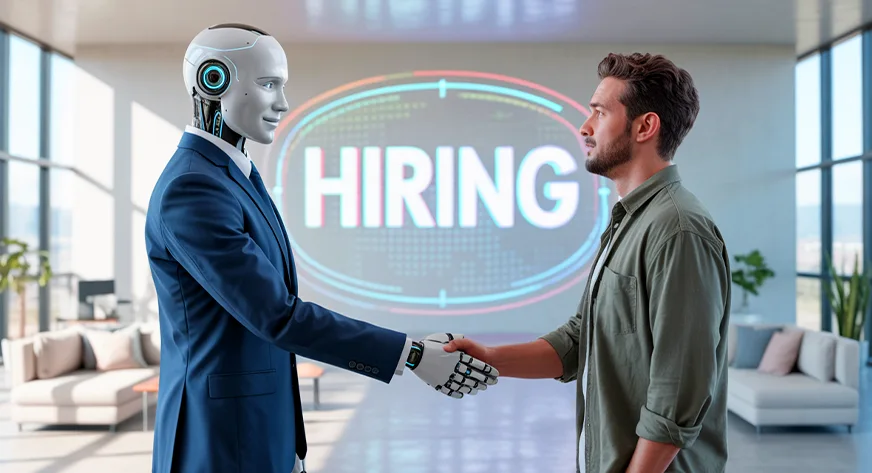
AI can screen 10,000 CVs in the time it takes a recruiter to read five. It can schedule interviews, rank candidates, and predict attrition risk with startling accuracy. And it still cannot tell you whether a person will actually thrive in your team. Here is the honest picture of what AI can and cannot do in recruitment — and what it means for how you hire.
FastHire Manpower Solution·12 min read·AI in Recruitment · Future of Hiring · Human-Led Staffing
The AI recruitment revolution is real — and it is already here
In 2026, artificial intelligence is no longer a future consideration for recruitment teams. It is an active participant in the hiring process across every major organisation in India and globally — parsing CVs, ranking applicants, scheduling interviews, conducting initial screening conversations, analysing video interviews for verbal and non-verbal cues, and predicting the probability that a candidate will still be employed 12 months after joining.
The scale of this shift is significant. What used to take a recruiter two weeks of manual CV screening now takes an AI system forty minutes. What used to require three rounds of human scheduling coordination now happens automatically. What used to be a gut-feel assessment of candidate enthusiasm is now a data-point derived from sentiment analysis of a video interview recording.
For HR Managers and Business Owners watching this change, the temptation is to frame it as either a threat or a salvation — AI is going to eliminate recruiting jobs, or AI is going to solve the talent crisis. Both framings are wrong. The accurate picture is more nuanced and more useful: AI is transforming which parts of recruitment are done by technology, which parts remain irreducibly human, and what the gap between those two categories reveals about the nature of hiring itself.
78%Of large Indian companies now use AI tools in at least one stage of recruitment
60%Reduction in CV screening time with AI-assisted shortlisting
43%Of AI-shortlisted candidates still require human re-evaluation before interview
31%Of companies report AI tools producing biased or inaccurate candidate rankings
The most important thing to understand about AI in recruitment is this: AI optimises for pattern matching. It is extraordinarily good at identifying candidates who look like your past successful hires. It is structurally blind to candidates who will become your best future ones — precisely because they do not match any existing pattern yet.
What AI is genuinely good at in recruitment — and where it falls short
AI recruitment tools are not uniformly good or uniformly bad. They excel at specific, well-defined tasks and fail at others in ways that are predictable and consistent. Understanding this map is the key to using AI intelligently — extracting the genuine value without importing the genuine risks. Explore each capability area below.
CV screening & ranking
Scheduling & comms
Skills assessment
Hiring analytics
Attrition prediction
Passive sourcing
CV Screening & Candidate RankingAI tools can process thousands of CVs against a defined requirement in minutes, ranking candidates by keyword match, experience pattern, and historical hiring data. This eliminates the manual screening bottleneck that accounts for the majority of time-to-fill delays in traditional recruitment.AI does well- Processes 10,000 CVs in under an hour
- Eliminates manual screening fatigue errors
- Applies consistent criteria at scale
- Identifies keyword and pattern matches instantly
- Flags duplicates and previously screened candidates
AI falls short- Misses unconventional but exceptional candidates
- Penalises non-linear career paths
- Amplifies historical bias if trained on past hiring data
- Cannot assess context behind employment gaps
- Ranks on pattern, not potential
The head-to-head: AI vs. human judgment across the hiring funnel
Across every stage of the hiring process, the question is not “should we use AI or humans?” It is “which decisions genuinely benefit from AI speed and scale, and which ones require human judgment, relationship, and contextual understanding?” The answers are not always obvious — and they are not always in favour of the humans.
AI approachCV rankingProcesses thousands instantly, applies rules consistently at scale AI wins on speed & scale
VS
Human approachCV rankingReads context, spots potential in unusual profiles, notices nuance Human wins on nuance
AI approachInterview schedulingCoordinates calendars instantly, sends reminders, handles rescheduling automatically AI wins clearly
VS
Human approachInterview schedulingTime-consuming, error-prone, requires back-and-forth coordination AI wins clearly
AI approachCultural fit assessmentAnalyses language patterns and responses — surface-level signals only Human wins decisively
VS
Human approachCultural fit assessmentReads energy, values alignment, team dynamic prediction, and authentic motivation Human wins decisively
AI approachCandidate engagementSends automated updates, answers FAQs, maintains communication cadence Adequate but impersonal
VS
Human approachCandidate engagementBuilds genuine rapport, addresses unstated concerns, manages competing offers with empathy Human wins on critical moments
AI approachSkills verificationTests defined technical skills with standardised assessments at scale AI wins for standardised skills
VS
Human approachSkills verificationProbes depth, identifies overstatement, assesses applied thinking and judgment under pressure Human wins for complex roles
AI approachOffer managementAutomates offer letter generation and basic follow-up Human wins clearly
VS
Human approachOffer managementReads candidate hesitation, neutralises competing offers, advises on structure and timing Human wins clearly
AI approachReference checkingSends automated reference forms — low response rates, surface answers Human wins decisively
VS
Human approachReference checkingBuilds rapport with referee, asks follow-up questions, reads hesitation and emphasis Human wins decisively
The five dangers of over-relying on AI in recruitment
AI adoption in recruitment is growing rapidly — but so is the evidence of what happens when organisations hand too much of the hiring decision to algorithms. These are the five failure modes that appear most consistently in businesses that have over-indexed on AI recruitment tools.
 Bias amplification — AI learns from your worst hiring decisions, not your best ones
AI ranking models trained on historical hiring data learn which candidates your company has historically hired — including all the unconscious biases embedded in those decisions. If your historical hires skew toward one educational background, one type of previous employer, or one demographic profile, the AI will systematically rank those profiles higher and deprioritise genuinely strong candidates who do not match the historical pattern.Fix: Audit AI rankings quarterly against actual hire quality outcomes. Actively test for demographic and background skew in shortlists.
Optimising for the wrong signal — CV keywords are not a proxy for job performance AI CV screening tools optimise for the presence of defined keywords and phrases. Candidates who know this — and in 2026, most experienced candidates do — craft CVs specifically designed to score well on AI ranking systems. The result is a shortlist of people who are excellent at writing CVs that match your job description, which is not the same as being excellent at the job described.Fix: Use AI screening as a first-pass volume filter only. Human assessment must validate before any candidate reaches interview stage.
Candidate experience damage — automated processes feel dehumanising to top talent High-performing candidates — the ones you most want to attract — have options. When they encounter a fully automated hiring process — chatbot screening, AI video interview, algorithmic ranking, automated rejection — they read the signal clearly: this company does not think the person they are hiring is worth a human conversation. Many of the strongest candidates self-select out before the process completes.Fix: Introduce human contact at every emotionally significant stage — shortlist notification, interview scheduling, and all feedback conversations.
False precision — AI scores feel more objective than they are When an AI tool produces a ranked shortlist with a candidate scored at 87.4% fit, it feels like objective data. It is not. It is a calculated output of the model’s training data, the quality of the job description input, and the specific parameters the tool was built around — all of which can be wrong in ways that are invisible to the user. The false precision of a numerical score can override genuinely important human judgment about a candidate.Fix: Treat AI scores as one data point among many, not as a conclusion. Never use an AI ranking as a substitue for human assessment.
Missing the exceptional outlier — the best hire is often the one who does not fit the pattern The candidates who go on to become the highest performers in any organisation frequently have non-linear career paths, unconventional backgrounds, or experience profiles that do not match the standard template for the role. AI pattern-matching systems are structurally designed to miss these people — because they excel at finding what looks like past success, not what will create future success.Fix: Reserve a portion of every shortlist for human-identified candidates who did not score well on AI ranking but show genuine promise on deeper review.
The most expensive AI recruitment failure is not a bad hire that AI selected. It is the exceptional hire that AI rejected — the candidate who would have changed the trajectory of the team, who was filtered out in round one because their CV did not match the pattern the algorithm was looking for, and who joined your competitor instead.
The irreducibly human dimensions of great recruitment
After mapping everything AI does well and everything it does badly, a clear picture emerges of the dimensions of recruitment that are not just currently human — but will remain human regardless of how sophisticated AI becomes. These are the capabilities rooted in emotional intelligence, contextual judgment, and the fundamental nature of human relationships.
- Reading what a candidate is not saying. The most revealing moments in a candidate conversation are often the pauses, the deflections, the phrases chosen carefully — and the ones avoided entirely. An experienced human recruiter reads these signals instinctively. An AI transcription and sentiment analysis tool sees words and tone. It does not see the human dynamic underneath them.
- Assessing genuine motivation, not stated motivation. Every candidate in every interview tells you they are passionate about the role and excited about the company. The human skill of distinguishing genuine excitement from practiced performance — and identifying the real drivers underneath a candidate’s career decisions — is not replicable by any AI system currently available.
- Managing the competing offer conversation. When a candidate receives a competing offer mid-process, the outcome is almost entirely determined by the quality of the human conversation that follows. Understanding the candidate’s real priorities, addressing their unstated concerns, and making a compelling case for your opportunity — with empathy and honesty — is a relationship skill. AI can draft a counter-offer email. It cannot have this conversation.
- Predicting cultural fit from unstructured conversation. Team chemistry, management style alignment, and values compatibility are determined by the texture of a conversation — not by a candidate’s responses to structured questions. A hiring manager who feels instinctively that a candidate will either thrive or clash in their specific team environment is reading information that AI cannot process.
- Building the relationship that makes a candidate choose you. In a competitive talent market, the best candidates always have options. The decision to accept one offer over another is rarely purely rational. It is shaped significantly by the quality of the human relationships built during the hiring process — with the recruiter, with the hiring manager, and with the team. That relationship cannot be automated.
The FastHire model — AI where it accelerates, humans where it matters
FastHire’s 48-hour delivery model uses technology intelligently throughout the process — to accelerate the stages where speed and scale are the primary requirements, while preserving human judgment at every stage where the quality of the outcome depends on it.
How FastHire integrates technology and human judgmentEvery stage mapped
TechnologyAI-assisted
Bench database management and initial match filteringOur talent bench database uses matching algorithms to surface the most relevant candidates from the pre-screened pool within minutes of a brief being received. Speed at this stage benefits the client and the candidate — no time wasted on obviously irrelevant profiles.
HumanSpecialist recruiter
Requirement intake and brief interpretationEvery FastHire brief is taken by an experienced specialist recruiter in a live conversation. The nuance of a client’s cultural context, management style, and the real reason the previous person in the role left — none of this appears in a job description. It emerges in a human conversation and shapes every subsequent matching decision.
BothAI + Human
Skills assessment — standardised layer plus human depth interviewFor roles with defined technical skills, AI-assisted assessments provide an objective baseline score. This is then validated by a human specialist who probes depth, application, and judgment — the dimensions that standardised tests cannot reach. Both layers are required before a candidate reaches the shortlist.
HumanSpecialist recruiter
Reference verification and candidate profilingEvery FastHire reference check is a live conversation — not a form. Our recruiters build rapport with the referee, ask follow-up questions based on what they hear, and read hesitation and emphasis as carefully as the words themselves. This stage is irreducibly human and is where the most valuable intelligence about a candidate is gathered.
HumanRelationship manager
Candidate engagement, offer management, and post-placement supportFrom shortlist delivery through to Day 90 check-in, every candidate and client interaction in the FastHire process is human-led. The offer conversation, the Day 7 retention check, the Day 30 health assessment — these are relationship moments that determine whether a placement succeeds. They will always be human at FastHire.
Where AI recruitment is heading — and what stays human
The trajectory of AI in recruitment over the next 3–5 years is clear in broad direction even if the specific capabilities are still developing. Understanding what is coming helps HR Managers and Business Owners make better decisions now about which AI investments to make and which human capabilities to protect and develop.
Now — 2026AI as screening accelerator and workflow toolAI handles CV ranking, scheduling, initial communications, and standardised skills assessment. Human judgment remains essential for cultural assessment, offer management, reference verification, and all relationship-critical interactions. The boundary is clear and relatively stable.
2027–2028AI as predictive talent intelligence layerAI systems will become significantly better at predicting candidate success in specific roles based on behavioural data, not just CV pattern matching. Attrition risk scoring, culture fit probability modelling, and performance trajectory prediction will become standard features of sophisticated ATS platforms — though all will require human validation.
2028–2030AI as proactive talent pipeline builderAI will increasingly identify and engage passive candidates before a role opens — mapping talent movements across LinkedIn, professional networks, and public data to predict who will be open to a move in the next 3–6 months. This will shift recruitment from reactive to genuinely proactive for companies with the infrastructure to support it.
Permanently humanThe judgment and relationship layer — this never changesRegardless of how sophisticated AI becomes, the assessment of genuine human motivation, the management of the candidate relationship at critical decision points, the reading of what is not said in an interview, and the human judgment of cultural fit will remain irreducibly human capabilities. The best recruiting organisations in 2030 will use AI heavily — and still employ brilliant human recruiters for exactly these reasons.The future of recruitment is not AI replacing humans. It is AI handling everything that can be systematised — giving human recruiters back the time and energy to do the things that cannot be. The best recruiter in 2026 is not the one who knows the most tools. It is the one who knows exactly which decisions require a human — and makes those decisions exceptionally well.
FastHire’s 48-hour delivery model is already the answer to the AI recruitment question for most businesses. We use technology where it accelerates — and human intelligence where it matters. The result is a shortlist that no AI-only system can match: pre-screened, reference-verified, contextually matched candidates, delivered in 48 hours, backed by a human relationship that extends through Day 90 of every placement.