Your turnover problem didn’t start when the employee resigned. It started the day you hired them.
Most businesses treat retention and recruitment as separate functions. The ones with the lowest attrition rates know they’re the same function — and they build their entire hiring process around that truth.
Employee turnover is one of the most expensive, disruptive, and demoralising cycles a business can fall into. And yet, in most organisations, it is treated as an HR problem that begins when an employee hands in their notice — triggering a reactive scramble to backfill, retrain, and rebuild. That framing is the core mistake.
The businesses with the lowest turnover rates don’t have better retention programmes. They have better hiring processes. They make fewer bad hires, fewer rushed hires, and fewer hires where the role, culture, or expectations were misrepresented or misunderstood from the start. The result is a workforce that stays, performs, and compounds — rather than one that cycles, drains, and costs.
This article breaks down exactly why most turnover begins at the hiring stage, what the true cost of that churn looks like, and how partnering with the right manpower solutions provider like FastHire Manpower Solution fundamentally changes the retention equation from day one.
50%
of voluntary employee exits occur within the first 18 months of joining
3×
annual salary — the total cost of replacing a mid-level employee who leaves
89%
of hiring failures stem from poor cultural fit — not lack of technical skills
70%
of attrition is preventable — when hiring decisions are made with the right information
The real cost of employee turnover — what the numbers don’t show
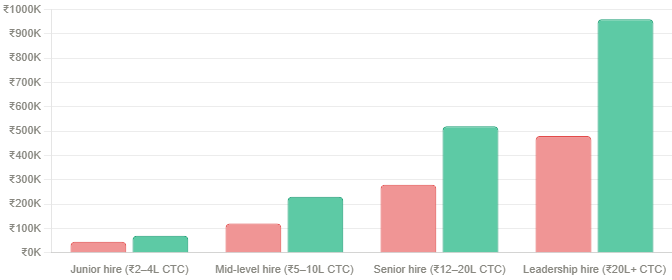
Most HR leaders can calculate the direct cost of turnover: recruitment fees, onboarding time, training investment, and the productivity gap during the vacancy period. That calculation is usually sobering enough. But the indirect costs — the ones that never appear on a single invoice — are where the real damage lives.
Team morale erosion
When a colleague leaves, the remaining team absorbs extra workload, loses institutional knowledge, and begins questioning their own commitment. One departure often triggers a cascade — the “why are they leaving?” conversation is infectious.
Client relationship disruption
Customer-facing roles carry relationship equity that walks out the door with the employee. The client relationship must be rebuilt from scratch — often in a competitive environment where rivals are ready to fill the gap.
Institutional knowledge loss
Process knowledge, vendor relationships, team dynamics insights, and undocumented expertise vanish when an experienced employee exits. This is rarely fully recovered — even by an excellent replacement.
Manager time drain
Each departure consumes significant leadership bandwidth in exit management, re-recruitment, re-onboarding, and team stabilisation — time pulled directly from strategic priorities and existing team development.
Employer brand damage
High turnover is visible. Candidates check Glassdoor. They talk to former employees. A reputation for churn makes quality talent self-select away before you ever get the chance to impress them in an interview.
Compounding hiring costs
Every departure triggers a new hire. Every new hire carries its own bad-hire risk. Without fixing the root cause — the hiring process itself — each replacement is just the next turn of an expensive, avoidable cycle.
Direct visible costsHidden indirect costs
Why most turnover begins at the hiring stage — the 6 root causes
Before you can fix attrition, you must trace it back to its origin. In the vast majority of cases, the seeds of an employee’s departure were planted long before they signed their offer letter. Here are the six most common hiring-stage root causes of employee turnover:
1
Role misrepresentation — the job they were sold vs. the job they got
Triggers: 30-90 day exits
When a job description overpromises — on growth opportunities, autonomy, team culture, or scope of responsibility — the new employee arrives with expectations the role cannot fulfil. Disillusionment sets in within weeks. The more senior the hire, the faster and more damaging the exit. This is not a retention failure. It is a hiring honesty failure, and it begins with how the role was briefed and presented during the recruitment process.
FastHire fix
FastHire conducts in-depth role briefing sessions with hiring managers — uncovering the real day-to-day reality of a role, not just the aspirational description. We then present that honest picture to candidates, ensuring the people who accept offers are genuinely excited about the role as it actually exists — not a version of it that doesn’t.
2
Culture mismatch — the most expensive invisible failure
Triggers: 3-12 month exits
A candidate can be technically brilliant and still fundamentally wrong for your organisation. Work pace, communication style, decision-making culture, leadership approach, and team dynamics are all invisible in a CV — and routinely overlooked in unstructured interviews that focus on credentials and technical ability. Culture mismatch doesn’t always announce itself quickly. Sometimes it simmers for months before the employee and organisation both acknowledge the inevitable. The exit, when it comes, is expensive and often avoidable.
FastHire fix
Every FastHire search begins with a culture mapping session — defining the non-negotiable behavioural traits, values, and working styles your environment demands. Every candidate is screened against these cultural parameters before you ever meet them. We don’t just fill roles. We match people to environments where they are genuinely set up to succeed and stay.
3
Hiring under pressure — urgency overrides quality
Triggers: Bad fits at all tenures
The single most reliable predictor of a bad hire is a hiring manager under time pressure. When a role has been vacant for weeks, when a client deadline is looming, when the team is stretched — the temptation to take the “best available” rather than the “genuinely right” candidate becomes irresistible. These pressure hires almost always underperform or leave within 12 months. The irony is devastating: rushing to fill a vacancy to ease team pressure creates a more expensive problem six months later.
FastHire fix
FastHire’s 72-hour shortlist delivery eliminates the time pressure that drives poor hiring decisions. When you know quality candidates will arrive within days — not weeks — there is no pressure to compromise on fit. Speed and standards stop being in conflict. That single structural change prevents more bad hires than any number of post-hire retention programmes.
4
Unclear career path — ambition without direction leads to departure
Triggers: 12-24 month exits
High-performing employees are intrinsically motivated by growth. When a role offers no clear trajectory — no defined next step, no development investment, no visible path to advancement — they begin looking externally. This is especially acute in India’s talent market, where ambitious professionals in their late 20s and 30s are highly mobile and evaluate career velocity as a primary decision factor. If your hiring process does not articulate a genuine growth path, you are recruiting people you will lose to organisations that do.
FastHire fix
FastHire’s consultants advise clients on how to frame career progression honestly and compellingly during the recruitment process. We help you present the trajectory — not just the role — so you attract candidates who are invested in growing with you rather than through you.
5
Compensation misalignment — discovering the gap too late
Triggers: 6-18 month exits
An employee who discovers — weeks or months into a role — that their compensation is materially below market rate does not quietly accept it. They update their resume. They take calls from recruiters. They leave when a better offer arrives, often within 6–18 months. Salary-driven attrition is almost entirely preventable — but only if compensation packages are benchmarked against current market data at the point of hire, not against last year’s salary bands or internal pay structures that haven’t been updated in 24 months.
FastHire fix
FastHire provides real-time compensation benchmarking for every role we fill — so your offer is built on live market data, not outdated surveys. Employees who are paid fairly from day one don’t spend their first year quietly shopping for a better offer.
6
Poor onboarding — winning the hire and losing the employee
Triggers: 30-90 day exits
A new employee decides within their first 30 days whether they made the right choice. If that experience is disorganised, culturally cold, or lacking in direction — if they feel invisible, unsupported, or unclear about how they fit — their psychological departure begins long before their formal one. Onboarding is the continuation of the hiring promise. Breaking it in the first month is the most expensive hiring mistake that most businesses never attribute to the hiring process — because by then, the recruiter has moved on and the exit appears in the “retention” bucket instead.
FastHire fix
FastHire’s post-placement support includes structured 30-day check-ins with both the placed candidate and the hiring manager — identifying integration issues early, before they become resignation letters. Our replacement guarantee period incentivises us to care about the hire’s success beyond the placement fee. We are invested in the outcome, not just the transaction.
“Retention is not a programme you implement after a hire. It is the accumulated result of every decision you made during the hiring process. Get the hiring right, and retention takes care of itself.”— FastHire Manpower Solution
The smarter hiring framework — three phases that build retention in
Reducing turnover through smarter hiring is not one intervention. It is a set of deliberate decisions across three distinct phases — before the hire, during the hire, and immediately after it.
Phase 1 — Before
Define the whole person, not just the role
Map the culture fit criteria, the career trajectory, the realistic day-to-day, and the growth investment before writing a single job description. The more honest and specific your brief, the better the match quality — and the lower the early attrition risk.
Phase 2 — During
Screen for fit as rigorously as for skill
Use structured, competency-based evaluation at every stage. Assess values alignment, communication style, growth mindset, and team compatibility — not just technical qualifications. Present the role honestly and listen as much as you speak.
Phase 3 — After
Own the first 90 days as a hiring responsibility
Treat onboarding as the final stage of the hiring process — not the first stage of the HR calendar. Structured integration, clear expectations, early feedback, and cultural immersion in the first 90 days dramatically reduce voluntary early exits.
Warning signals your current hiring process is breeding turnover
The signs are usually visible — if you know what you’re looking for. Here are the patterns that indicate your hiring process is contributing to the attrition problem:
High 90-day exit rateRepeated exits in same roleOnboarding complaints commonOffers accepted then withdrawnManager frustration with hiresCulture fit issues cited at exitSalary complaints within 6 monthsRole expectation gaps reported
And here are the signals that smarter hiring — typically supported by a specialist manpower solutions partner — is working:
12+ month avg. tenure increasingOffers consistently acceptedNew hires performing by day 30Culture fit cited as strengthRehire rate above 15%Manager confidence in hires highCandidate referrals increasingInternal promotions growing
The retention paradox most businesses fall into: They invest heavily in retention initiatives — wellness programmes, team events, flexible policies, recognition schemes — while continuing to make the same hiring mistakes that generate the attrition in the first place. Retention programmes treat the symptom. Smarter hiring eliminates the cause. Both matter, but the leverage is overwhelmingly on the hiring side.
Your smarter hiring checklist — build retention in from day one
Brief your recruitment partner on culture, not just qualifications — the values, behaviours, and working styles that predict success and longevity in your team
Present the role honestly — day-to-day reality, growth path, team dynamics, and leadership style — not just the aspirational version designed to attract interest
Use structured, competency-based interview frameworks that assess cultural and motivational fit alongside technical skill — and apply them consistently to every candidate
Benchmark compensation against live market data before making an offer — not against internal pay bands that haven’t been updated in 18 months
Move fast enough that top candidates never feel the need to hedge — accept counter-offers or consider alternatives — before your offer lands
Design the first 90 days as intentionally as you designed the interview process — with clear milestones, cultural integration moments, and early feedback loops built in
Conduct structured 30-day, 60-day, and 90-day check-ins between the new hire, their manager, and your recruitment partner — catching friction early, before it becomes a notice letter
Track your early attrition rate (exits within 12 months) as a key hiring quality metric — and hold your recruitment partner accountable to it through a meaningful replacement guarantee
How FastHire builds retention directly into every placement
At FastHire Manpower Solution, we don’t measure our success by placements made. We measure it by placements that last. Every aspect of our staffing services is engineered to deliver not just great candidates, but great long-term fits — people who stay, grow, and contribute rather than cycle through your organisation at significant cost.
Culture-first briefing
Before every search, we map your culture, values, and team dynamics — ensuring every candidate we submit is screened for fit as rigorously as for skill.
Honest role presentation
We present roles truthfully to candidates — setting realistic expectations that prevent the disillusionment-driven exits that plague the first 90 days.
Live compensation benchmarking
Every offer we support is built on current market data — eliminating the salary gap discoveries that quietly drive exits 6–18 months post-hire.
72-hour delivery — no pressure hires
Our speed eliminates the urgency that causes compromised hiring decisions. Quality and speed stop competing when your pipeline is already live.
Post-placement check-ins
We stay engaged after the hire — conducting structured check-ins at 30, 60, and 90 days to catch integration issues before they become exit decisions.
Replacement guarantee included
Every permanent placement carries a replacement guarantee — so if an early exit does occur, your hiring investment is fully protected at no additional cost.