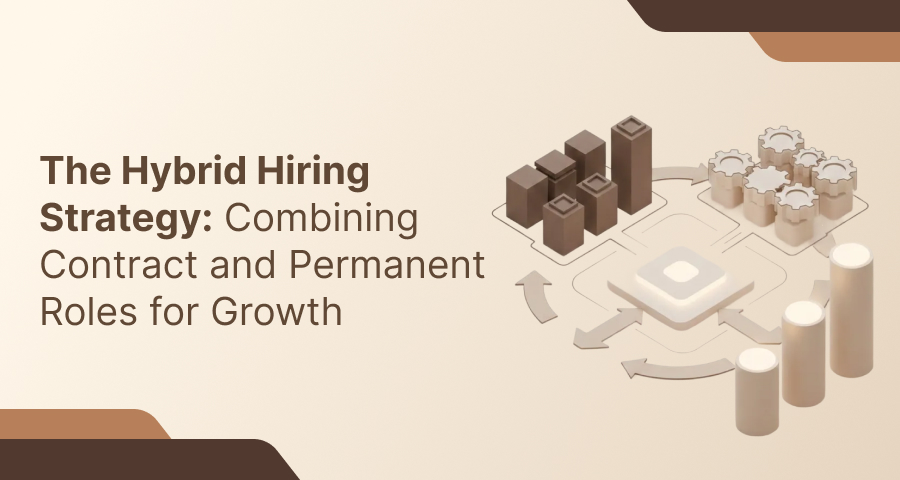
The most agile companies in India are not choosing between contract and permanent staff — they are building a deliberate blend of both. It is not a compromise. It is the most strategically intelligent workforce model available in 2026, and it is delivering results that neither approach alone can match.
For years, the conversation about workforce composition has been framed as a binary choice: permanent employees for stability and culture, contract workers for flexibility and cost control. Businesses picked a side based on their dominant need and accepted the limitations of their chosen model. Permanent-heavy organisations struggled to scale during demand surges. Contract-heavy ones struggled to build institutional knowledge and team cohesion.
The smartest businesses in Ahmedabad, Surat, Pune, and across India’s industrial and commercial centres have quietly moved past this debate. They have stopped asking “contract or permanent?” and started asking a more sophisticated question: “For each role and each business context, what is the right employment model — and what is the optimal blend across the whole workforce?”
The answer to that question is the hybrid workforce model. And the companies that have built it deliberately — with a clear framework for which roles should be permanent, which should be contract, and how the two pools interact — are consistently outperforming those that have not on every metric that matters: cost efficiency, scaling speed, retention of key talent, and resilience in the face of demand uncertainty.
The hybrid workforce is not a cost-cutting measure dressed up as strategy. It is a structural capability — the ability to expand and contract your workforce at the pace of your business, while protecting your core team’s stability, culture, and institutional knowledge. When it is built deliberately, it is the most competitive workforce model available to any business regardless of size.
The four forces driving the hybrid workforce shift
The move toward hybrid workforce models is not a trend driven by preference — it is being accelerated by four structural forces that are reshaping how Indian businesses think about headcount, cost, and organisational agility.
Force 1 — Demand volatility is the new normal. Global supply chains, export cycles, e-commerce seasonality, and post-pandemic demand patterns have made predictable, linear business volume a thing of the past for most sectors. A workforce model built entirely on permanent headcount assumes stable demand — an assumption that fewer and fewer businesses can make with confidence. The hybrid model replaces that assumption with adaptability.
Force 2 — The cost of permanent employment has risen. PF contributions, ESIC, gratuity obligations, notice periods, and the administrative complexity of retrenchment under Indian labour law have all increased the true cost and commitment associated with permanent hiring. Businesses are not abandoning permanent employment — they are becoming more deliberate about which roles justify that commitment and which do not.
Force 3 — Top talent increasingly prefers flexibility. Experienced professionals across sales, IT, operations management, and specialist technical roles are choosing contract engagements deliberately — for the variety, the premium compensation, and the autonomy. The best contract workers are not people who could not find permanent jobs. They are high-performers who have chosen this model. Access to them requires a staffing partner with a relationship-based talent bench, not a job portal.
Force 4 — Project-based business models are expanding. Infrastructure, IT services, pharma clinical trials, construction, and consulting are all organised increasingly around discrete projects rather than continuous operations. The workforce requirement has the same project shape — a defined team for a defined duration, with the ability to dissolve and reform for the next engagement. Permanent headcount is structurally mismatched to this model.
The framework for deciding: permanent vs. contract by role type
The most practically useful part of building a hybrid workforce model is having a clear, role-by-role decision framework. Here is how to categorise every role in your organisation — and what that categorisation means for your hiring approach.
Senior leadership and managers whose decisions shape the business
Roles where institutional knowledge compounds over time
Client relationship owners and account managers
Technical leads and architects whose loss disrupts the team
Production floor roles tied to order volume fluctuations
Project-specific technical specialists
Seasonal demand roles — logistics, packaging, processing
IT implementation and rollout specialists
Roles in new markets or functions being piloted
Replacement hires where cultural fit is uncertain
Junior roles with potential for growth into core positions
Convert to permanent at 90 days if performance confirms fit
Mid-level supervisors in stable, predictable environments
Same role in a high-growth or uncertain demand context
Sales roles in established territories with proven pipeline
Sales roles in new territories being tested for viability
The risk comparison — what each model exposes you to
Every workforce model carries risk. The question is not how to eliminate risk — it is how to manage it intelligently. Here is how the three main workforce models compare across the risks that matter most to business leaders and HR Managers.
The hybrid model does not eliminate every risk — no workforce model does. But it is the only model that manages the full portfolio of risks simultaneously: cost flexibility when demand drops, speed when demand surges, cultural stability through the permanent core, and compliance protection through a specialist staffing partner who handles contract workforce obligations.
How to transition to a hybrid workforce model — a 4-stage roadmap
For businesses currently running an all-permanent or predominantly permanent workforce, the move to a hybrid model does not require a disruptive restructure. It is a gradual, role-by-role architectural shift that happens over 3–6 months with the right planning and the right staffing partner.
Stage 1 — Month 1Audit and categorise your current workforce by role typeMap every role in your organisation against the permanent vs. contract framework. Identify which roles are genuinely core (institutional knowledge, client relationships, leadership) and which are volume, project, or surge roles that the hybrid model would handle more efficiently. This audit typically takes 2–3 working days and produces a clear hybrid architecture blueprint for your specific business.
Stage 2 — Month 1–2Identify your first contract conversion opportunitiesRather than restructuring existing roles — which creates legal and cultural complexity — focus your first hybrid moves on natural transition points: roles that become vacant through attrition, new roles being created for project-specific needs, and surge capacity requirements for known demand peaks. These are your lowest-friction entry points into the hybrid model, with zero disruption to your existing permanent team.
Stage 3 — Month 2–4Engage FastHire as your contract staffing partner and build your benchBriefing FastHire on your role categories, quality standards, and business context allows us to begin building a dedicated bench of pre-screened candidates for your specific requirements. This is not reactive sourcing — it is proactive pipeline development. By the time your first contract requirement arrives urgently, the candidates are already identified, already assessed, and already aligned to your environment. Deployment happens in 48 hours because the preparation happened weeks earlier.
Stage 4 — Month 4–6Optimise the model — convert, extend, or release based on performance dataThe hybrid model’s most powerful feature is the contract-to-permanent conversion pathway. At the 90-day mark on any contract placement, you have real performance data — not just interview impressions — to inform a permanent conversion decision. High-performing contract workers who are invited to join permanently bring three months of proven performance, established relationships, and zero onboarding ramp. This is the most evidence-based permanent hiring decision any company can make.
Integrating contract workers into a permanent team — what actually works
The most common failure point in hybrid workforce models is not the sourcing or the cost structure — it is the cultural integration of contract workers into a team that is predominantly permanent. When contract workers feel like visitors rather than contributors, the quality of their work and their reliability both decline. When they feel genuinely included, they perform at their ceiling and often become your most enthusiastic advocates for joining permanently.
- Onboard contract workers with the same rigour as permanent hires. A 2-hour structured orientation — team introduction, role expectations, supervisor briefing, communication norms — applied to every contract worker dramatically reduces early attrition and accelerates time-to-productivity. The investment is 2 hours. The return is measurable within the first week.
- Communicate transparently about the nature and duration of the engagement. Contract workers who know their engagement is for 3 months, with a defined possibility of extension or conversion based on performance, are more engaged than those who feel uncertain about their future. Clarity builds commitment — ambiguity creates disengagement.
- Include contract workers in team communications, meetings, and recognition. The fastest way to create a two-tier culture that damages performance on both sides is to visibly exclude contract workers from the team’s shared experience. Include them in briefings, celebrate their contributions, and give them the same respect and information as permanent team members.
- Create a defined conversion pathway for high performers. Make it explicitly known that strong performance during a contract engagement is the fastest route to a permanent offer. This single policy change transforms the motivation of contract workers from “deliver enough to extend the contract” to “perform at the level that earns a permanent place.” The quality difference is significant and immediate.
- Give contract workers a named point of contact for issues. Not just their direct supervisor — a dedicated HR or operations contact who is responsible for their experience as a FastHire-placed worker. This contact is also how FastHire’s post-placement team stays connected to the quality of the integration.
The companies that integrate contract workers most successfully are not the ones that blur the distinction between contract and permanent — they are the ones that respect both models equally. A contract worker who is treated as a valued contributor for the duration of their engagement will perform better, refer others, and respond positively to a permanent offer when it comes. One who is treated as temporary and disposable will deliver exactly that much — and leave the moment something better appears.
How FastHire powers your hybrid workforce — both sides of the model
FastHire Manpower Solution is built to serve the hybrid workforce model in its full complexity — not just the contract side, and not just the permanent side, but the whole architecture and the transitions between them.
For contract staffing, FastHire’s pre-screened talent bench means your surge capacity and project-specific roles are filled in 48 hours with verified, role-ready candidates. We handle all statutory compliance — PF, ESIC, contract documentation — removing the administrative burden from your HR team entirely. And our replacement guarantee means that a mid-engagement dropout is a 48-hour resolution, not a production crisis.
For permanent placement, FastHire’s role-specific assessment process and reference verification model means that every permanent hire reaches your shortlist already verified — with performance evidence, reference check highlights, and an interview guidance note that tells your hiring manager exactly what to probe and what to expect. The same 48-hour shortlist standard applies to permanent roles as to contract ones.
For the contract-to-permanent transition — the moment that defines the hybrid model’s strategic value — FastHire’s post-placement tracking gives you and us a real-time view of how each contract worker is performing. When the 90-day conversion decision arrives, it is informed by three months of verified performance data, our Day 30 retention health assessment, and a FastHire recommendation on conversion readiness. The most evidence-based permanent hiring decision your business can make — powered by the data that only a post-placement tracking model can provide.
The hybrid workforce is not the future of work. It is the present of work — and the companies that build it deliberately today will have a structural competitive advantage in talent access, cost efficiency, and organisational agility that their all-permanent and all-contract competitors will find very difficult to replicate in a hurry.
Build your hybrid workforce with FastHire.
Whether you need contract staff deployed in 48 hours, a permanent placement backed by pre-screening and a replacement guarantee, or a strategic partner to help you design the right blend for your business — FastHire is built for all three. Contact us today and let’s design your hybrid workforce model together.